
 EN
 FR
 JA
 RU
 ES
 AR
 BG
 CS
 DA
 NL
 FI
 DE
 EL
 HI
 IT
 KO
 NO
 PL
 PT
 RO
 SV
 TL
 ID
 LT
 SR
 UK
 VI
 HU
 TH
 TR
 FA
 AF
 MS
 GA
 EU
 LA
 NE
 KK
 UZ
Paper Bowl Capacity vs. Working Fill: Choosing Space for the Whole Meal
A capacity label makes it easy to shortlist packaging. It does not tell you whether a complete meal will fit and remain practical to prepare. For an instant food project, the useful question is not simply ‘How many milliliters is the bowl?’ It is ‘What space does this product need at each stage of use?
Clarify what the listed capacity describes
Ask the supplier how capacity is measured. Do not assume that a listing describes either brimful capacity or a recommended working fill unless the specification says so. Working fill should be established for the intended food and use conditions. It should not be created by applying an unsupported percentage to the number in a product title.
Keep the capacity description, intended food portion and any proposed fill mark as separate items on the approval record. This prevents a packaging label from becoming an unintended promise about portion size.
Review the meal before and after preparation
For a dry-filled instant meal, assess the space occupied by the main ingredient, toppings and any enclosed sachets before sealing. Then assess the preparation stage: water addition, mixing and access with the intended utensil. Where the food changes volume during preparation, observe that change using the actual recipe rather than a substitute chosen only for convenience.
Headspace is the space left above the intended contents. Set it through an application review that considers closure, handling and preparation. A fill level that is convenient during packing may not be convenient when the consumer stirs the meal.
Compare shape instead of capacity alone
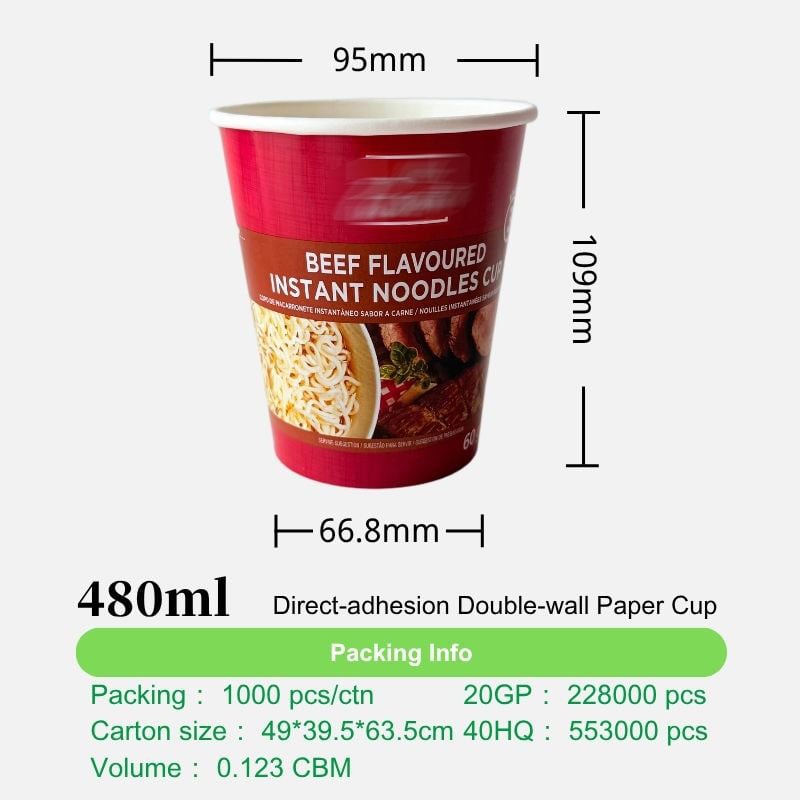
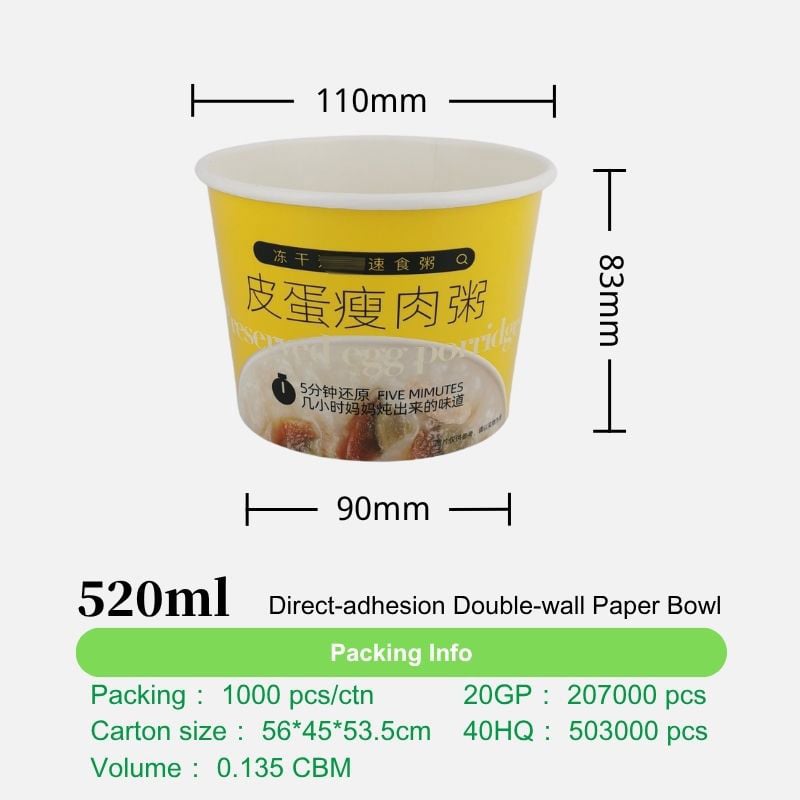
YBLPAK lists its 480ml direct-adhesion double-wall cup with a 95mm top diameter, 66.8mm bottom diameter and 109mm height. Its 520ml porridge bowl is listed at 110mm, 90mm and 83mm respectively. These are different geometries, not simply two capacity labels.
The figures help identify which samples to review. They do not prove that either format suits a specific noodle block, topping arrangement or filling line. Check the internal usable space and relevant tolerances with the supplier; external dimensions should not be treated as an exact internal volume model.
Run a portion trial that reflects intended use
• Record the candidate packaging model and sample revision.
• Load the intended ingredients in the planned sequence.
• Check that the closure can be applied without interference from the contents.
• Prepare the product using the proposed consumer instructions.
• Review mixing, utensil access and the remaining space above the food.
• Record the outcome and the conditions that produced it.
Use the results to decide whether to adjust the portion, package geometry or preparation instructions. If a recipe or serving size changes later, review the working fill again rather than assuming the previous result remains valid.
YBLPAK’s instant food cup and bowl range provides starting points for sample selection. Share your portion format and preparation sequence to discuss a candidate configuration before committing to artwork or a fill mark.